
Could Shaking Hands Be a Sign of Parkinson’s Disease?
Introduction
You notice your hand trembling while lifting a cup of chai—or see it in your father’s hand while signing a cheque. It’s easy to immediately worry about Parkinson’s. But a shaking hand does not always mean Parkinson’s disease. If you’re exploring Parkinson’s disease treatment in Ahmedabad, it’s important to first understand what may be causing the tremor and when to consult a doctor.
Is Shaking in the Hands Always Parkinson's?
No, not at all. Hand tremor has many causes, and most are harmless or easily treated.
Parkinson’s disease affects roughly 1 in 100 people over the age of 60. It happens when brain cells that make dopamine slowly weaken. Dopamine is a chemical that helps your brain send smooth, controlled movement signals. When levels drop, movements become slow, stiff or shaky.
Still, a tremor that keeps coming back deserves a proper look. The pattern of the shaking often tells the doctor a great deal.
What Does a Parkinson's Tremor Look Like?
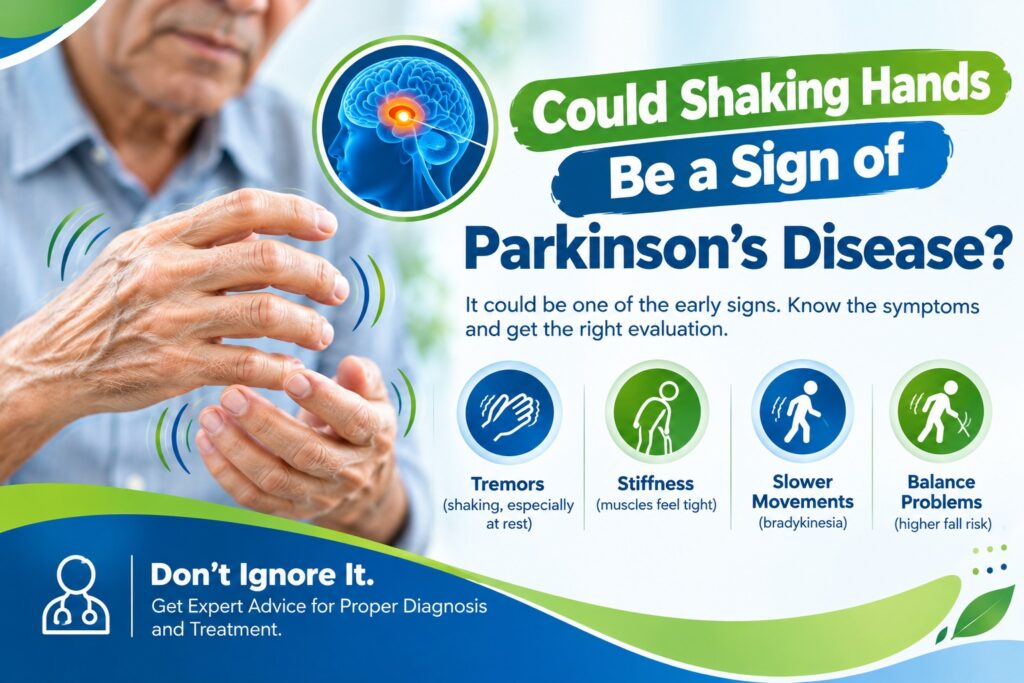
Parkinson’s tremor has a few typical features:
- It happens at rest. The hand shakes while it sits in your lap or hangs by your side.
- It often starts on one side. One hand, or sometimes one leg, is affected first.
- It looks like rolling a pill. The thumb and finger rub together in a slow, rhythmic motion.
- It eases with movement. Many people find the shaking calms when they pick up a glass or write.
- It gets worse with stress or tiredness, and disappears during sleep.
How is it different from essential tremor?
Essential tremor is much more common than Parkinson’s, and the two are often confused.
|
|
Parkinson's tremor
|
Essential tremor
|
|---|---|---|
|
When it appears
|
At rest
|
While using the hands
|
|
Typical sides
|
Often starts on one side
|
Usually both hands
|
|
Other features
|
Slowness, stiffness
|
Mainly shaking, sometimes the head or voice
|
|
Family history
|
Less often
|
Often present
|
Essential tremor is much more common than Parkinson’s, and the two are often confused.
What Else Can Make Hands Shake?
Before assuming the worst, consider these common triggers:
- Too much caffeine. Strong tea or coffee can set off a fine tremor.
- Anxiety and stress. Nervous energy makes hands tremble.
- Low blood sugar, especially in people with diabetes.
- An overactive thyroid. This often comes with weight loss, sweating and a racing heartbeat.
Which Other Early Signs Should I Look For?
Parkinson’s rarely arrives as shaking alone. Doctors look for a group of changes:
- Slowness of movement. Buttoning a shirt or brushing teeth takes longer than before.
- Stiffness. Arms or legs feel tight, and the shoulder may ache.
- Small, cramped handwriting that shrinks as you write.
- Reduced arm swing while walking, or shorter, shuffling steps.
- A soft or mumbling voice.
Can Parkinson's Start Without Any Tremor?
Yes, and this surprises many people. Most people with Parkinson’s develop a tremor at some stage, but some never do. Their first signs may be slowness, stiffness or walking trouble.
So if your family member moves slowly, walks with small steps or has lost their expression, it is still worth getting checked even if their hands are steady. Early signs are often put down to “old age,” which delays help.
How Do Doctors Find Out What Is Wrong?
There is no single blood test or scan that confirms Parkinson’s. A neurologist, ideally one who focuses on movement disorders, reaches the diagnosis by:
- Listening to your story, including how symptoms began and what medicines you take
- Examining you. Tapping your fingers, walking, checking muscle tone and watching for tremor are all part of it.
- Ordering tests to rule out other causes, such as thyroid and B12 levels
- An MRI of the brain, mainly to exclude other conditions
What Does Parkinson's Disease Treatment in Ahmedabad Involve?
Treatment aims to control symptoms and help you stay independent for as long as possible. It is tailored to each person. A good plan usually has several parts.
Do exercise and therapy really matter?
Very much. They are as important as the medicine itself.
- Physiotherapy improves walking, balance and flexibility.
- Speech therapy helps with a soft voice and swallowing.
- Occupational therapy shows you easier ways to dress, eat and write.
- Regular exercise, such as brisk walking, cycling, yoga, tai chi or dance, helps slow the decline in movement.
What about surgery?
Deep brain stimulation (DBS) is an option for selected patients. Gentle electrical pulses calm the faulty brain signals. It suits people whose medicines still work but wear off unpredictably, or who have troublesome extra movements. It does not cure Parkinson’s, and it is not right for everyone.
Is mental health part of treatment?
Yes. Low mood, anxiety and poor sleep are very common in Parkinson’s. They are part of the condition, not a weakness, and they can be treated. Tell your doctor about them.
Final Thought
A shaking hand is often nothing serious. But if it keeps returning, affects only one side or comes with slowness, stiffness or other changes, a neurologist’s opinion can bring clarity. Even if the answer is Parkinson’s, you will be glad to know early, because treatment works best when it starts on time.
For those who do need care, Parkinson’s disease treatment in Ahmedabad offers a full range of support, from medicines and therapy to advanced options like deep brain stimulation. You do not have to face it alone, and you do not have to wait until daily life becomes difficult.
A consultation with Dr. Chirag Solanki can help you understand what your symptoms mean and which treatment suits you best. You will get a careful evaluation, honest answers and time to ask every question, with no pressure.