Can My Child Return to School 2 Weeks After Brain Surgery?
Introduction
It’s one of the first questions parents ask once the initial shock of surgery settles down: “When can my child go back to school?” Two weeks feels like a common benchmark parents hear about, but the honest answer depends heavily on the child, the condition, and the type of procedure performed. Here’s what actually determines the timeline, based on how recovery is typically managed under Paediatric Neurosurgery in Ahmedabad.
Is Two Weeks Really Enough Time?
it depends on the type of surgery. For simpler, lower-risk procedures like shunt placement for hydrocephalus, two weeks can genuinely be realistic for at least a partial return, think half-days, reduced workload, and no physical education initially. For more complex brain or spine tumor surgeries, two weeks is often just the point where a child is comfortable at home, not necessarily ready for a full school routine. There’s no single fixed answer that applies to every child.
Why There's No One Fixed Timeline
Children heal differently from adults, often faster, but “faster” doesn’t mean identical across all cases. A child who had a straightforward shunt placement may bounce back within two weeks. A child recovering from a complex brain tumor resection, on the other hand, may need a much longer runway before returning to a full school day.
The real answer lies in a mix of factors: the type of surgery, how the child is healing physically, and how their brain function is holding up cognitively and emotionally.
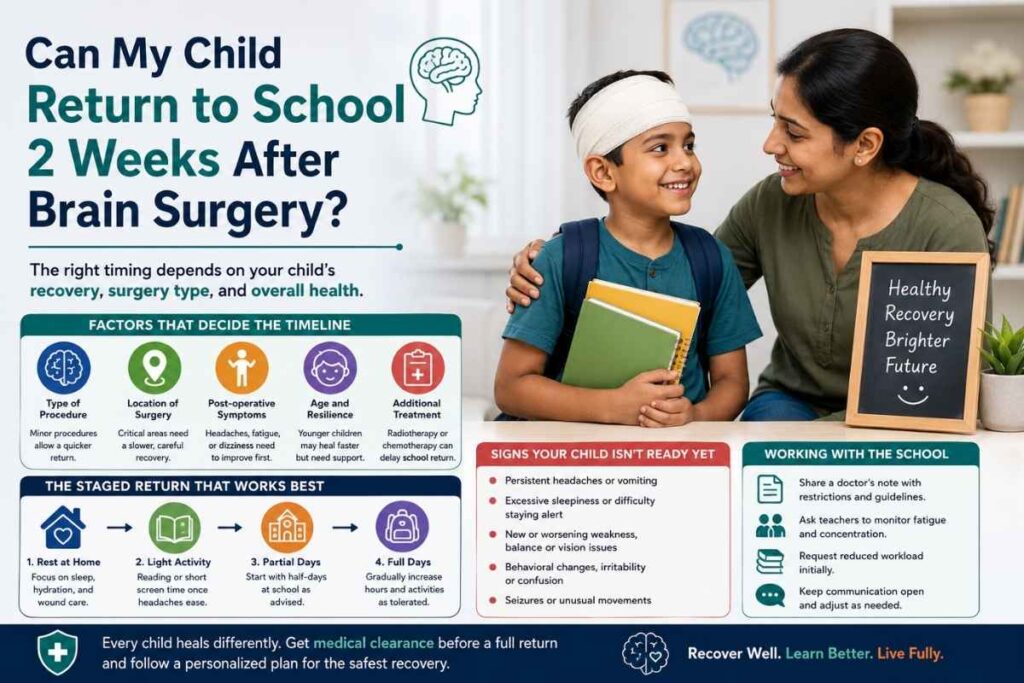
Factors That Decide the Timeline
Type of procedure — Minor procedures like shunt surgery or minimally invasive interventions generally allow a quicker return than major open surgeries for tumors or trauma.
Location of the surgery — Surgeries near areas controlling speech, memory, or motor skills often need a slower, more supervised return, even if the incision itself has healed.
Post-operative symptoms — Headaches, fatigue, dizziness, or difficulty concentrating are common in the first few weeks. These need to settle before a child can manage a full classroom day.
Age and resilience — Younger children sometimes recover physically faster, but may need more support adjusting emotionally to the hospital experience.
Additional treatment — If radiotherapy or chemotherapy follows surgery, common in some paediatric brain tumors, the school return timeline shifts significantly and is planned around treatment cycles, not just surgical recovery.
The Staged Return That Works Best
Rushing a full return, even with good intentions, often backfires with fatigue, irritability, or a dip in concentration. A staged approach tends to work far better:
- Rest at homefor the first several days, focusing on sleep, hydration, and wound care
- Light mental activitylike reading or short screen time, once headaches ease
- Partial school days, once cleared by the neurosurgeon, often starting with mornings only
- Full school days, gradually reintroducing physical activity and longer hours based on how the child copes
Signs a Child Isn't Ready Yet
Parents should hold off on a full school return if the child shows persistent headaches or vomiting, unusual sleepiness or difficulty staying alert, new or worsening weakness, balance issues, or vision changes, behavioral changes like increased irritability or confusion, or seizures, if not previously present or increasing in frequency. Any of these warrant a call to the neurosurgical team before pushing ahead with school plans, since none of them should simply be waited out at home.
Sports and physical activity typically need to stay on hold for several weeks to months after surgery, well beyond the classroom return, and the exact timeline depends entirely on the type of procedure and how well healing is progressing.
Working With the School
Before your child returns, it helps to loop in the school directly. Share a written note from the treating neurosurgeon outlining any restrictions, such as no sports, reduced screen time, or scheduled rest breaks. Ask teachers to flag any signs of fatigue or difficulty concentrating during the first few weeks, and request a reduced homework load initially if cognitive symptoms are still settling. Keep communication open in case the return needs to be paused and restarted. Most schools are cooperative once they understand the medical context, so a short, clear note from the doctor goes a long way.
Why a Doctor's Clearance Matters More Than a Calendar Date
Every child’s clearance to return to school should come after a proper follow-up assessment, not just a calendar countdown. This typically includes a neurological examination, a review of the surgical site, and, in some cases, updated imaging. Skipping this step and going by “two weeks” alone can be risky, especially after major brain or spine surgery. A follow-up visit confirms the child is both physically and cognitively ready, rather than relying only on how many days have passed since the operation.
Dr. Chirag Solanki, a fellowship-trained paediatric neurosurgeon with extensive experience managing brain and spine conditions in children, generally recommends a personalized timeline for every child rather than a fixed number of days, since recovery patterns can vary a lot even between children with similar diagnoses.
Conculsion
Two weeks can work for simpler procedures, but complex surgeries often need longer. Watch for lingering symptoms like headaches, fatigue, or behavioral changes before pushing for a full return. A staged approach, rest, light activity, partial days, then full days, works better than jumping straight back into the routine. And always get medical clearance before a full school return, not just a date circled on the calendar.
If you’re planning your child’s return to school after treatment under Paediatric Neurosurgery in Ahmedabad, schedule a follow-up with Dr. Chirag Solanki’s team first to get a recovery timeline tailored to your child’s specific condition.