Can You Have a Normal Life After Neurosurgery?
Introduction
If you or someone you love has just been told that brain or spine surgery is needed, your mind probably jumped straight to one question: “Will life ever feel normal again?” It’s one of the most common worries patients bring up before any neurological procedure, and it’s a fair one. Surgery on the brain or spine sounds frightening because these are the systems that control everything we do, from walking to speaking to remembering a loved one’s name.
The honest answer is yes, in most cases, patients do return to a full and active life after neurosurgery. But how smooth that journey is depends on several factors: the type of surgery, how early the condition was caught, the surgeon’s skill, and how committed the patient is to recovery. As the best neurosurgeon in Ahmedabad, Dr. Chirag Solanki has guided thousands of patients through this exact journey, and this article breaks down what recovery really looks like, based on real clinical experience rather than guesswork.
Why People Fear Life After Brain or Spine Surgery
Neurosurgery carries a certain stigma. Movies and TV shows often portray it as a last resort with uncertain outcomes. In reality, the field has changed enormously over the past two decades. Procedures that once required large incisions and long hospital stays can now often be done with minimally invasive techniques, smaller cuts, less blood loss, and faster healing.
Still, the fear is understandable. People worry about losing memory, movement, speech, or independence. Some worry about becoming a burden on their family. These concerns are valid, which is why choosing an experienced and well-trained surgeon matters so much. The skill of the surgical team directly affects how well a patient bounces back.
What Recovery Actually Looks Like
Recovery isn’t a single event; it happens in stages.
- The first few days after surgery are mostly about rest, monitoring, and pain management. The medical team watches closely for any signs of complications and helps the patient get back on their feet, sometimes literally, within a day or two for many spine procedures.
- The next few weeks focus on rebuilding strength and confidence. Physiotherapy often plays a big role here, especially after spine surgery or procedures involving movement disorders. Patients gradually take on small daily tasks again: walking short distances, dressing independently, and resuming light activity.
- The following months are about returning to normal routines. Most patients can go back to desk jobs within four to six weeks, depending on the surgery. Physically demanding work usually takes longer. For procedures like Deep Brain Stimulation (DBS) used in Parkinson’s disease, patients often notice a meaningful improvement in tremors and daily function once the device is calibrated, which can genuinely transform quality of life.
It’s worth noting that recovery timelines vary a lot. A simple disc surgery heals faster than a complex tumor removal. This is why personalized care plans matter more than generic recovery charts.
Factors That Influence a Normal Life After Surgery
A few things consistently determine how well someone recovers:
- Type and location of the condition – A small, well-localized tumor behaves very differently from a more complex or deep-seated one.
- Timing of treatment – Catching a problem early, before it puts pressure on nerves or critical brain structures, usually leads to better outcomes.
- Surgical technique – Modern, minimally invasive, and image-guided approaches reduce trauma to surrounding tissue.
- Post-surgery rehabilitation – Physiotherapy, speech therapy, or occupational therapy (depending on the case) speeds up functional recovery.
- Patient mindset and support system – Patients with strong family support and a positive outlook often recover faster, both physically and emotionally.
Can Patients Return to Work, Hobbies, and Daily Life?
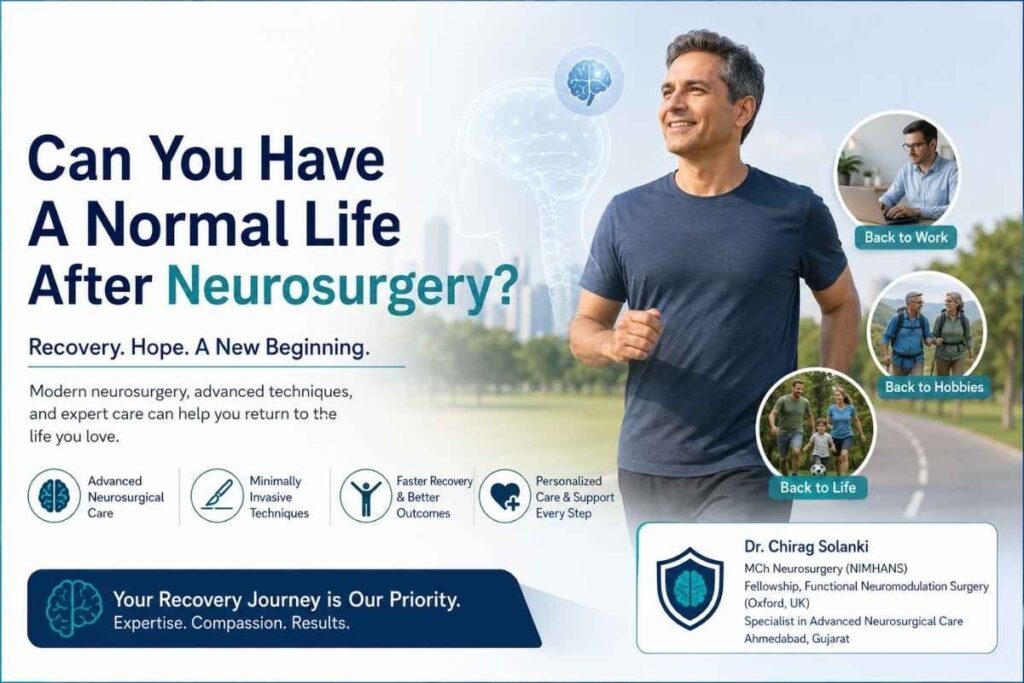
Yes, in the large majority of cases. Many patients treated for conditions like tremors, epilepsy, herniated discs, or pituitary tumors go back to their jobs, hobbies, and social lives within weeks to a few months. Even patients undergoing more complex procedures like brain tumor removal or aneurysm repair often regain full or near-full function with the right surgical approach and follow-up care.
Of course, some conditions come with permanent changes that need to be managed rather than completely reversed. In these situations, “normal” might look a little different than before, but it’s still a life filled with independence, purpose, and meaningful activity.
Choosing the Right Neurosurgeon Matters
This is perhaps the single biggest factor in long-term outcomes. A neurosurgeon’s training, hands-on experience, and approach to patient care directly shape recovery. Dr. Chirag Solanki trained at NIMHANS, one of India’s leading neuroscience institutes, and completed a fellowship in Functional Neuromodulation Surgery at Oxford, UK. As one of the first specialists in Gujarat to offer advanced treatments like Deep Brain Stimulation for Parkinson’s disease and epilepsy surgery, he combines global surgical standards with a patient-first approach.
What truly sets good neurosurgical care apart isn’t just technical skill; it’s also communication. Patients recover better when they understand their condition, know what to expect at each stage, and feel supported throughout. This is the kind of care that turns a frightening diagnosis into a manageable journey.
Final Thoughts
Neurosurgery is no longer the life-altering, fear-inducing event it once was perceived to be. With advances in surgical technology, better diagnostic tools, and experienced specialists, most patients go on to lead active, independent, and fulfilling lives after their procedure. The key lies in early diagnosis, the right surgical expertise, and consistent post-operative care.
If you or a family member is dealing with a neurological condition and searching for trusted, experienced care, consulting an established specialist can make all the difference. Dr. Chirag Solanki, recognized as one of the leading names in neurosurgical care in Gujarat, offers the kind of evidence-based, compassionate treatment that helps patients not just survive surgery, but truly thrive afterward.