Brain Tumor Surgery Survival Rates: What Are My Chances?
Introduction
Imagine this: an MRI report lands on the table, and the words “brain tumor” jump out before anything else registers. The mind immediately races to one question — how much time do I have, and what are the chances surgery actually works?
This is the moment most patients walk into a neurosurgeon’s clinic in. And it’s also the moment where real facts need to replace fear-driven assumptions. If you’re exploring brain tumor surgery in Ahmedabad, here’s a clearer, more grounded way to understand your chances.
Step One: Understanding What Kind of Tumor You're Dealing With
Survival rates don’t start with a percentage — they start with a diagnosis. Brain tumors fall into broad categories: benign growths like meningiomas, which tend to grow slowly and respond well to surgery, and malignant tumors like gliomas, which behave more aggressively and need a more intensive treatment plan.
This single distinction changes everything downstream — the urgency of surgery, the surgical approach, and what recovery and long-term outlook actually look like. So the real first step isn’t searching survival statistics; it’s getting precise imaging and, where needed, a biopsy to know exactly what you’re facing.
Step Two: Why Location Inside the Brain Changes the Difficulty
Not all tumors are equally accessible. A tumor sitting in a less critical area of the brain may be removed more completely with lower risk. But a tumor near areas controlling speech, movement, or vital functions requires far more careful planning — sometimes with the patient kept partially awake during surgery to monitor these functions in real time.
This is where experience becomes the deciding factor. A surgeon who has handled hundreds of complex, high-risk locations approaches these cases very differently than one with limited exposure to such tumors.
Step Three: The Surgery Itself — Where Outcomes Are Actually Decided
Here’s something patients rarely hear clearly: survival isn’t decided by diagnosis alone — it’s heavily influenced by what happens in the operating room. Maximum safe resection — removing as much of the tumor as possible without damaging healthy brain tissue — directly affects long-term outcomes.
Neuro-navigation guided surgery allows the surgical team to map the tumor’s exact boundaries during the operation, improving precision well beyond what’s possible with the naked eye alone. Intraoperative monitoring tracks brain activity continuously, alerting the team the moment a critical area is at risk, which helps prevent permanent damage during removal.
This is exactly why patients are encouraged to look for the best neurosurgeon in Ahmedabad, rather than choosing surgery based on cost or convenience alone. The surgical decisions made in those few hours shape years of life afterward.
Step Four: What Happens After Surgery Matters Just as Much
Survival doesn’t end at the operating table. For malignant tumors, post-surgical treatment such as radiotherapy or chemotherapy often plays a major role in long-term outcomes. This is why a coordinated approach — neurosurgery working closely with oncology teams — tends to produce better results than treatment handled in isolated silos.
Recovery also depends on consistent follow-up: repeat imaging to monitor for regrowth, physiotherapy if movement was affected, and ongoing neurological assessment to catch any changes early.
Step Five: Where Dr. Chirag Solanki Fits Into This Journey
Dr. Chirag Solanki, fellowship-trained at NIMHANS and Oxford, has built his neuro-oncology practice around this exact step-by-step philosophy — accurate diagnosis first, precise and function-preserving surgery second, and coordinated long-term care third.
Having performed thousands of neurosurgical procedures, his approach leans heavily on individualized planning rather than standardized protocols. For complex cases near critical brain regions, tools like neuro-navigation and selective awake-surgery techniques are used specifically to protect functions like speech and movement, not just to remove the tumor.
What patients consistently mention is the clarity they receive at each stage — understanding exactly what their tumor type means, what surgery can realistically achieve, and what recovery will involve, rather than being left with vague reassurances.
So, What Are Your Real Chances?
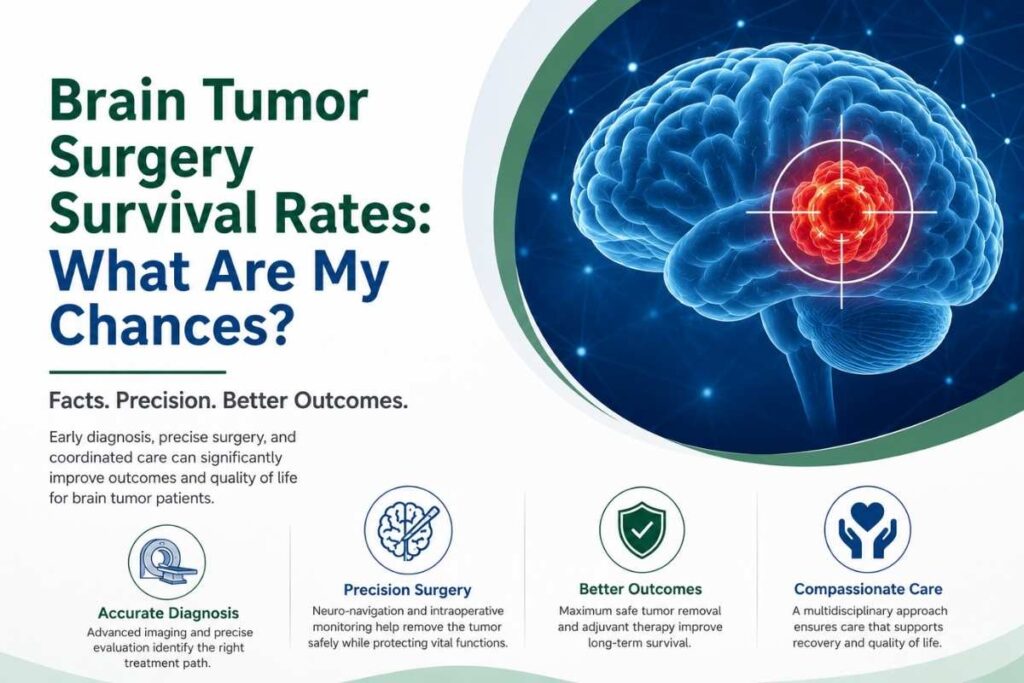
Here’s the honest answer: nobody can give you a meaningful number without your scans, your tumor type, and your overall health in front of them. What can be said with confidence is this — early diagnosis, precise surgery, and coordinated follow-up care consistently improve outcomes, regardless of which broad statistic you’ve read online.
If you’ve been searching anxiously for brain tumor surgery in Ahmedabad, the most useful next step isn’t another search query — it’s sitting down with an experienced specialist who can walk you through your specific case, step by step, the way it actually unfolds in real treatment.