Is Yoga an Effective Treatment for Parkinson's Disease?
Introduction
If you or a family member has been diagnosed with Parkinson’s, you’ve probably come across articles claiming yoga can “cure” tremors or replace medication. It’s a comforting idea, but it isn’t quite accurate. Let’s look at what yoga can realistically do, and where it fits alongside proper medical care like the best parkinson’s disease treatment in Ahmedabad.
So, Does Yoga Actually Help?
Yoga is not a cure, but there’s genuine, growing evidence that it helps manage symptoms. Parkinson’s disease affects movement, balance, and muscle control because of falling dopamine levels in the brain. Yoga doesn’t restore dopamine, but it directly targets the physical and mental symptoms that come with the condition.
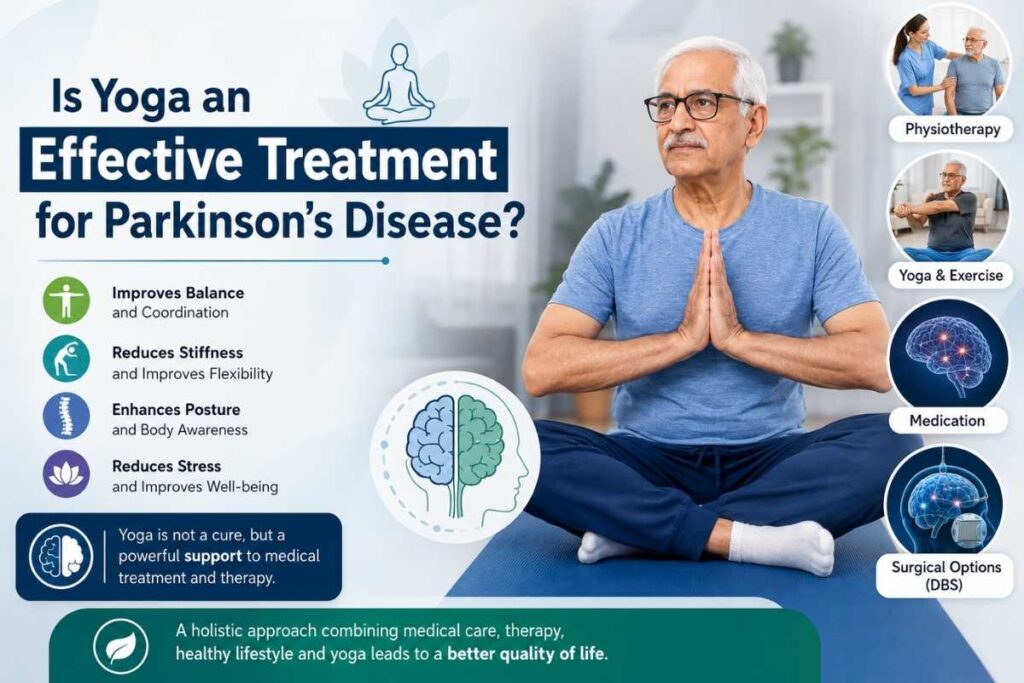
Here’s what regular, guided yoga practice can realistically improve. Balance and coordination tend to get better, since many Parkinson’s patients struggle with falls due to poor stability, and slow, controlled yoga poses train the body to steady itself over time. Muscle stiffness, one of the most frustrating symptoms of Parkinson’s, often eases with gentle stretching-based sequences that loosen tight muscles and improve range of motion. Flexibility and posture also benefit, since Parkinson’s often causes stooped posture, and poses that open the chest and spine help patients stand taller and move more freely. Stress and anxiety, both common non-motor symptoms, respond well to the breathing exercises (pranayama) practiced in yoga, which are known to calm the nervous system and improve sleep quality. And mind-body awareness improves too, as slow, mindful movement helps patients become more attuned to their body’s signals, building confidence in daily activities.
What Yoga Cannot Do
This part matters just as much. Yoga cannot slow the underlying degeneration of dopamine-producing brain cells, and it’s not a substitute for medication or, in advanced cases, surgical treatment like Deep Brain Stimulation (DBS). Patients who stop their prescribed treatment in favor of yoga alone often see their symptoms worsen faster, not slower. Think of yoga as one supporting pillar in a much bigger treatment plan, not the whole structure.
Which Type of Yoga Actually Works?
Not every yoga style suits Parkinson’s patients. Fast-paced or highly flexible styles like power yoga can actually increase fall risk. What tends to work well instead is chair yoga or wall-supported yoga for patients with balance issues, Hatha yoga practiced slowly with a focus on breath and posture, restorative yoga for stress relief and better sleep, and guided sessions with an instructor experienced in movement disorders rather than a general fitness class. It’s always best to start under supervision, ideally with input from a physiotherapist who understands Parkinson’s-specific movement challenges.
Where Yoga Fits Into a Complete Treatment Plan
A well-rounded approach to Parkinson’s care usually combines several elements working together: medication to manage dopamine levels and control motor symptoms, physiotherapy to build strength, balance, and mobility, yoga or supportive exercise to maintain flexibility and reduce stress, surgical options like DBS for advanced cases where medication alone isn’t enough, and regular neurological follow-up to track progression and adjust the plan. This is exactly the kind of multidisciplinary approach followed for patients seeking the Best Parkinson’s Disease Treatment in Ahmedabad, where medical management, therapy, and surgical intervention are considered together rather than in isolation.
When Should You See a Specialist Instead of Just Practicing Yoga?
Yoga can be started early and continued long-term, but it should never delay a proper diagnosis. See a neurologist or functional neurosurgeon without delay if you notice tremors that are getting worse or spreading, increasing stiffness that limits daily activities, frequent falls or balance problems, slurred speech or reduced facial expression, or medications that no longer control symptoms as well as before. Yoga is meant to work alongside a medical plan, not to be used as a screening test to decide whether one is needed.
Dr. Chirag Solanki, a fellowship-trained Functional Neurosurgeon and one of the earliest specialists in stereotactic and functional neurosurgery in the region, often highlights that lifestyle measures like yoga work best when they’re layered on top of an accurate diagnosis and a proper medical plan, not used as a replacement for one.
Foods That Support Brain Healing
Once the patient is stable and back home, the focus shifts to nutrient-dense foods that actively help recovery. Protein-rich foods like eggs, paneer, moong dal, chicken, and fish help repair tissue and rebuild strength, and protein is arguably the single most important nutrient during this phase. Fruits and vegetables such as berries, papaya, spinach, and carrots are rich in antioxidants that help reduce inflammation around the surgical site. Healthy fats from walnuts, flaxseeds, and a moderate amount of ghee or olive oil support nerve function and hormone balance. Whole grains like brown rice, oats, and whole wheat rotis provide steady energy and help prevent constipation, a common issue after surgery due to reduced mobility and pain medication. And staying hydrated with plain water, buttermilk, and ORS solutions helps flush out anesthesia by-products and keeps the body functioning smoothly.
Quick Recap
Yoga supports balance, flexibility, stress relief, and posture in Parkinson’s patients, but it does not stop disease progression and cannot replace medication or surgery. Gentle, supervised styles of yoga work better than fast-paced or advanced yoga, and the most effective results come from combining yoga with medical treatment rather than choosing one over the other.
If you’re exploring options for Parkinson’s disease treatment in Ahmedabad, a consultation with Dr. Chirag Solanki’s team can help you develop a comprehensive treatment plan, one where yoga, therapy, and medical care work together.