Will Brain Surgery Affect My Memory or Personality?
Introduction
One of the first things patients ask when they find out they need brain surgery is — will I still be me after this? It is a fair question. The brain controls who we are — how we think, feel, remember, and respond. So when someone hears the words “brain tumor surgery,” fear about personality changes or memory loss often hits harder than the fear of the surgery itself.
Let’s talk about this honestly.
Why This Fear Makes Complete Sense
The brain is not like a knee or a shoulder. Every part of it does something important. Certain areas manage memory. Others handle speech, emotion, decision-making, or movement. So yes — surgery in or near those areas carries real risks. Anyone who tells you otherwise is not being truthful.
But here’s what also needs to be said: the risk is not the same for every patient, every tumor, or every surgeon. The location of the tumor, the surgical technique used, and the experience of your neurosurgeon all play a major role in what happens after the operation.
What Can Actually Change After Brain Surgery
After brain tumor surgery in Ahmedabad or anywhere else, some patients do notice temporary changes. These may include:
- Mild forgetfulness or difficulty concentrating
- Feeling more emotional or irritable than usual
- Slower thinking or word-finding trouble
- Fatigue that affects mood and behavior
Most of these are short-term. The brain is a remarkable organ — it adapts. With proper post-operative care and rehabilitation, many patients recover these functions over weeks or months.
Permanent changes are less common, but they can happen — especially if the tumor itself was already affecting brain function before surgery. In those cases, surgery may actually improve things, because removing the tumor takes pressure off healthy brain tissue.
How Surgeons Protect What Matters
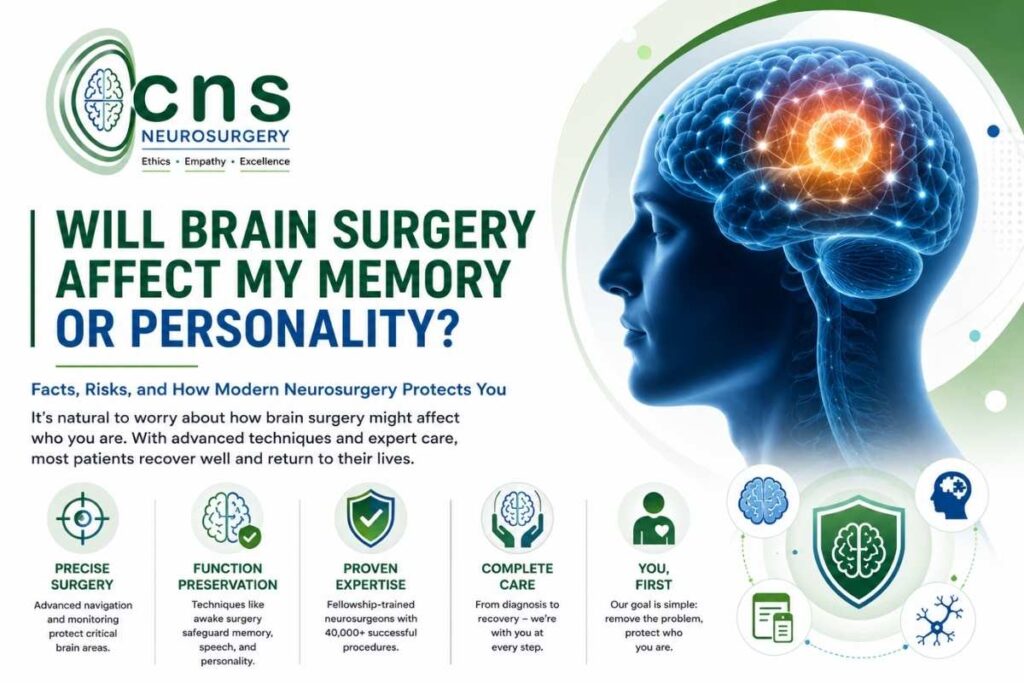
Modern neurosurgery is nothing like what it was even a decade ago. Surgeons now use tools and techniques that were not available before — and this has significantly improved how much function can be preserved.
Dr. Chirag Solanki, a fellowship-trained neurosurgeon based in Ahmedabad, uses several advanced approaches during brain tumor surgery:
- Awake Brain Surgery — In selected cases, the patient is kept awake during parts of the procedure. This allows the surgical team to monitor speech and movement in real time. If a critical area is at risk, the surgeon adjusts accordingly. This technique is particularly effective when tumors are close to areas controlling language or motor function.
- Intraoperative Neuromonitoring (IONM) — Continuous brain monitoring during surgery helps detect any changes in neural activity the moment they occur, giving the surgeon immediate feedback to prevent damage.
- Neuro-Navigation Systems — Think of this as GPS for the brain. It allows for highly precise mapping of the tumor and surrounding structures, so the surgeon knows exactly where they are at every step.
- Keyhole and Minimally Invasive Approaches — Smaller incisions, less trauma to surrounding tissue, and faster recovery. These techniques reduce disruption to healthy brain regions.
The goal with all of these is simple: remove as much of the tumor as safely possible while protecting the functions that define your quality of life.
The Tumor Itself Can Change You — Surgery Often Helps
This is a point many patients miss. A growing brain tumor puts pressure on surrounding tissue. Depending on where it sits, it can already be causing memory problems, mood swings, personality changes, or behavioral shifts — before any surgery takes place.
In such cases, operating is not the cause of the change. It may actually reverse it. Patients who undergo successful tumor removal often report that they feel more like themselves afterward than they did during the months when the tumor was growing undetected.
Recovery Is a Process, Not a Switch
Even when surgery goes well, the brain needs time. Post-operative swelling, anesthesia, and the general stress of the procedure can cause temporary cognitive fog. This is normal and usually improves steadily.
Dr. Chirag Solanki’s approach includes comprehensive pre- and post-operative neurological care — not just surgical expertise, but ongoing monitoring of how the patient is recovering mentally and emotionally, as well as physically. Multidisciplinary support, including coordination with oncology teams when needed, ensures that care does not stop at the operation table.
Questions Worth Asking Your Surgeon
Before brain tumor surgery, ask your doctor these directly:
- Is the tumor close to memory or speech areas?
- What technique will you use to protect those areas?
- Will I need awake surgery or neuromonitoring?
- What changes, if any, should I expect after surgery?
- What does post-operative rehabilitation look like?
A good neurosurgeon will not rush past these questions. They are as important as any scan or blood report.
Talk to a Specialist Before Fear Makes the Decision
Brain tumor surgery is not something to delay out of fear of what might change. With the right surgeon, the right technique, and the right post-operative plan, many patients go on to live full, functional lives.
If you are looking for brain tumor surgery in Ahmedabad, consult Dr. Chirag Solanki — fellowship-trained at NIMHANS and Oxford, with over 40,000 neurosurgical procedures and a focused approach to preserving who you are, not just removing what is wrong.
When to Seek Expert Opinion
If you or someone in your family has been diagnosed with a brain tumor — or if symptoms like memory problems, behavior changes, or new-onset headaches are being investigated — early evaluation matters. The earlier a tumor is identified and assessed, the more surgical options are available, and the better the chances of protecting brain function.